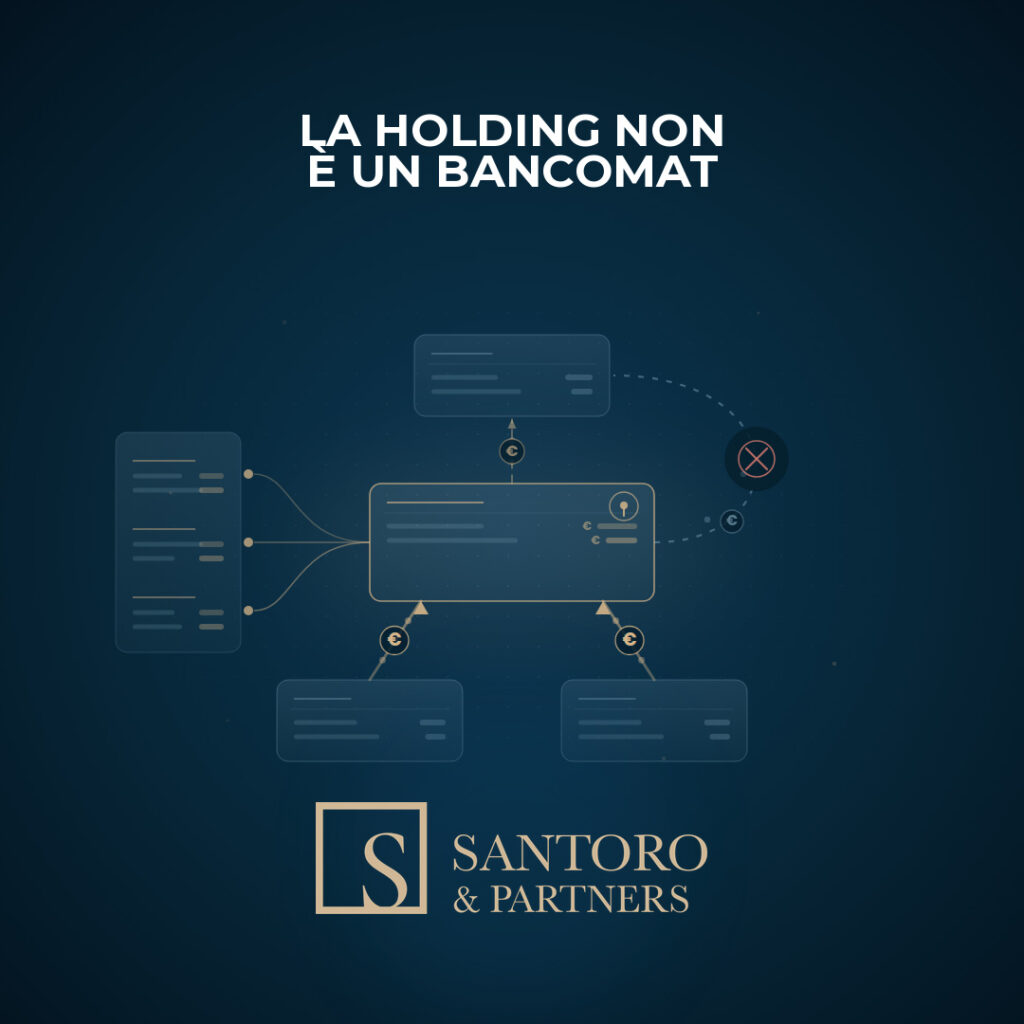
A holding company does not eliminate the tax: it defers it, while allowing those resources to be used to grow the business in the meantime. The problem is almost never setting it up, which the law permits. It is what happens afterward with the cash.
For some time now, an appealing idea has been circulating: you set up a holding company, contribute your operating company’s shares to it, and from that moment profits cost 1.2% instead of 26%. Put that way, it is a half-truth. And in tax matters, half-truths are the most expensive kind.
The holding company works, and works well. But it works for what it is: a vehicle that holds shareholdings, governs the group, builds up resources and reinvests them. When the operating company distributes profits to the holding company, the levy is minimal. But when those same profits need to reach the entrepreneur, as an individual, in their personal bank account, taxation reverts to the usual rates.
Where things go wrong
The problem is almost never setting up the holding company, which the law permits and which the Italian Revenue Agency, even in 2026, has repeatedly recognized as legitimate. The problem is what is done afterward with the cash. Anyone who thinks of channeling that money back to the shareholder through indirect means, refunding reserves, repaying shareholder loans created for the occasion, or registering the family’s seaside home and boat in the holding company’s name, is turning an organizational tool into a challengeable transaction.
What the Agency said this summer
Examining a contribution in kind followed by the distribution of dividends to the holding company and the repayment of shareholder loans, the Agency ruled out abuse, but on one precise condition: if, in practice, the cash had served solely to return money to the shareholder, the ruling would have been different (Ruling no. 155 of August 7, 2026).
The message is clear: the same transaction can be legitimate or abusive depending on how the cash is used in subsequent years.
The paths that seem more elegant but are not
Refunding the reserve created by the contribution in kind does not work as long as the company has profits, because the law presumes that those are the first to be distributed and taxes them as dividends. Selling your own shares to a subsidiary, which takes on debt to pay for them and repays that debt with dividends, is a scheme the tax authorities have long considered potentially abusive. Finally, using the holding company as a personal cash reserve generates taxable income for the shareholder and costs that the company cannot deduct.
The opposite risk: idle cash
There is also the opposite risk: a holding company that accumulates funds and does nothing with them. No one is required to distribute profits, and a challenge based merely on retaining cash is legally weak. But idle cash, without a plan or a horizon, is still a signal that attracts questions during an audit.
What holds up
What holds up is a holding company that acts like a holding company: financing group companies, acquiring new shareholdings, supporting investments, preparing for generational succession, managing assets with a clear policy. What holds up is a dividend paid to the shareholder as a dividend, with the related taxes.
And what holds up, above all, is a transaction that speaks for itself: minutes that explain the choices made, an investment plan, governance consistent with the reasons stated from the outset. The non-tax reasons for a holding company are not proven by writing them into the deed, but by what the holding company does in the years that follow.
The group’s safe
The holding company remains one of the most effective tools for organizing business assets. For this very reason, it should be treated for what it is: the group’s safe, not the shareholder’s ATM.